Robotics · UCLA · ECE 183D / MAE 162D
Busserbot
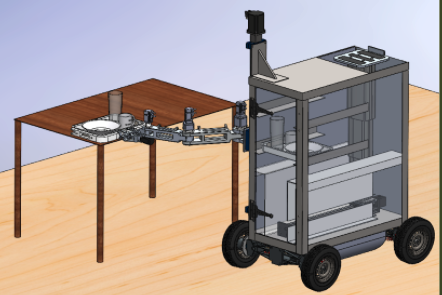
An autonomous robotic busser built for UCLA's joint ECE 183D / MAE 162D capstone: a storage unit and multi-joint robotic arm coordinated through trajectory-planning velocity control, validated across three Webots simulations.
Built & validated storage unit and robotic arm carried from CAD and technical drawings through to 3 working Webots simulations
The brief
Automating restaurant bussing means a robot that can navigate a dining room, reach onto a table, and stack dishes into a mobile storage unit — a problem that spans mechanical design, kinematics, and systems integration, not just software. That was the brief for Team People’s ECE 183D / MAE 162D capstone, a joint electrical and mechanical engineering course at UCLA run across two quarters: 183DA for the preliminary design, 183DB for critical design and build.
Seven of us worked it: four from ECE (myself, Semira Galijasevic, Shahrul Kamil, Jeffrey Yu) and three from MAE (Justin Chandra, Ricardo Martinez, Naravit Vichathorn), each covering a distinct subsystem. Mine was the robotic arm’s control logic and the systems integration tying every subsystem together.
What I built
- Trajectory planning for the arm, prescribing joint velocities rather than just target positions — forward and inverse kinematics plus cubic-polynomial motion profiles, worked out in MATLAB before being carried into the controller
- Systems integration logic in Webots connecting the arm controller to the storage subsystem, so pickup, transport, and stacking run as one coordinated sequence rather than three independent scripts
- The Python control stack the whole robot runs on, coordinating the arm, gripper, and storage cart controllers against the simulated environment
Where it landed
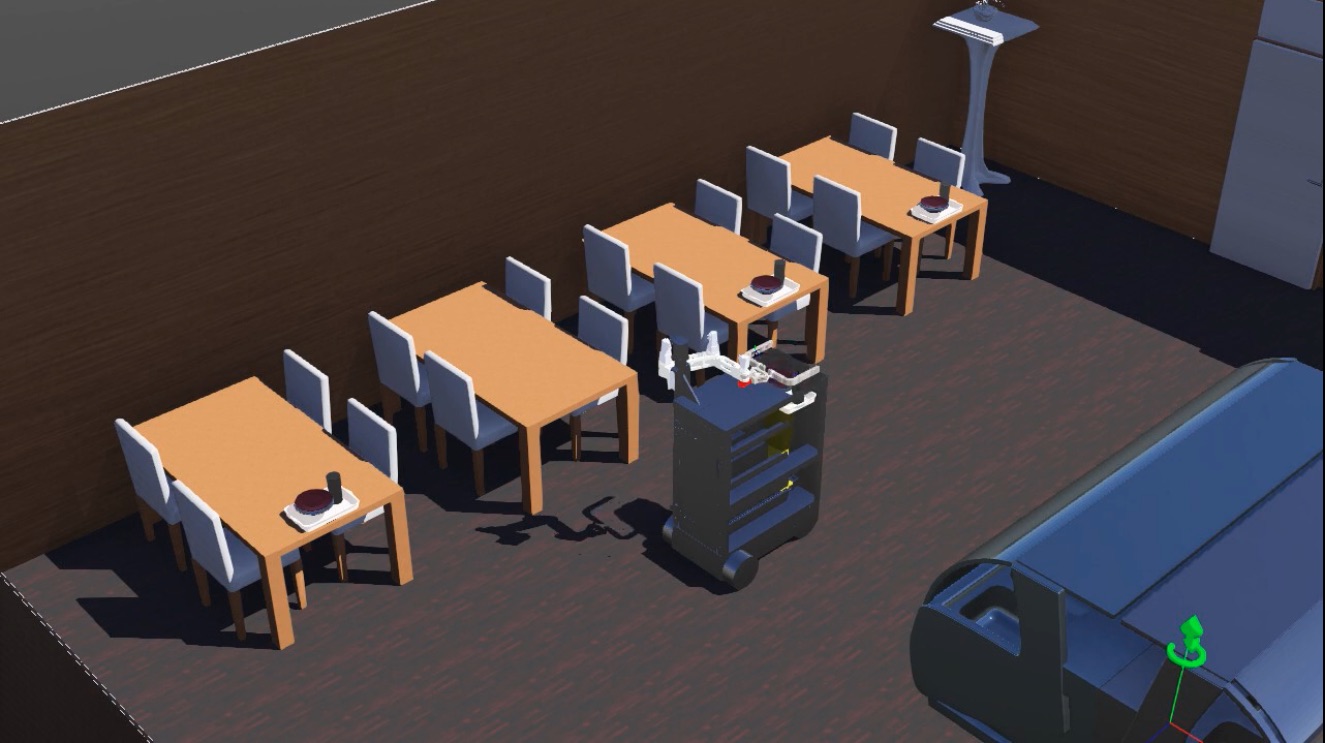
The storage unit and robotic arm went from CAD and physical technical drawings through to three separate validated Webots simulations, each recorded on video: a full pickup-to-delivery cycle across a full dining room, a single stationary arm-reach test, and a storage-only run. SolidWorks motion analysis backed up the mechanical design alongside the simulation work.
It’s coursework, not a shipped product — the honest version of this story is a capstone grade, not a production deployment. But the kinematics, the trajectory planning, and the systems-integration problem of getting independently-designed subsystems to actually work together as one machine are the same problems that show up in any real robotics or automation system, just without a paying customer on the other end yet.